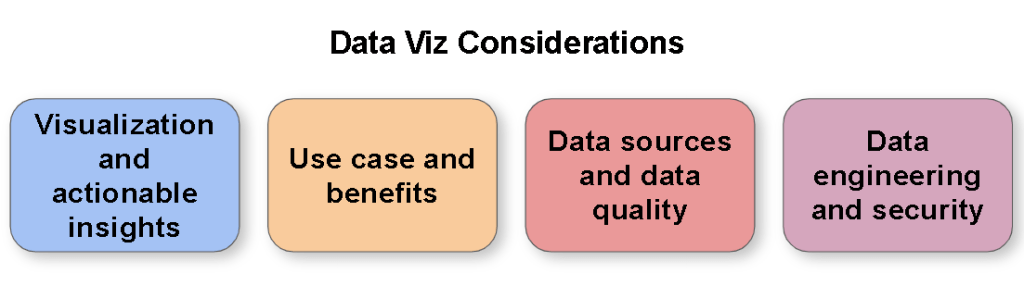
When I’m asked to look into a Data Viz use case, there are a number of questions to consider, obviously “it depends”, but generally these are the sorts of things I think through, and I wanted to share as it might help you in your data visualization activities!
- Use case and benefits: What is the use case benefit? Has that been signed-off on and agreed yet or do you need to analyse it first and engage with stakeholders? Is there a deadline for delivery?
- Quick win or long term solution: Is this a short term solution or an urgent requirement to deliver a quick win? Or does it need to be operationally robust and require a more substantial design? Often you can deliver a MVP to provide immediate value whilst working on the longer term solution.
- Data availability: Is the data sourced/available? Are there security implications? 3rd party sources? Technical implications (volume, velocity, variety…)? Is there a sample of data I can start working on? Beware the data iceberg…
- Data model: What is the size/complexity of the data set? Are there many sources? Is there a defined schema/data model? What data engineering might be required to process the data into structures to support the data visualization? Are you going to create a re-usable data product that can be used for other solutions?
- Data quality: Do you expect to undertake data cleansing/data analysis? What challenges might there be with the with how the data is collected, is the right data being collected to support the use case?
- Report timeliness: What is the expected frequency of updating the report (eg real time, intra-day, daily, weekly, monthly)? Always challenge stakeholders on what is really required, everyone would love real time data, but there is typically a lot more effort and engineering required to implement that kind of solution.
- Report performance: Given the tools and technology (data engineering, data viz) available what are the possibilities or limitations? What are the performance considerations, do you have non-functional requirements to meet?
- Logic and calculations: Are there any complex calculations expected with the data? Is everyone aligned on the calculation logic and definitions? What calculations to implement in the data sources, or the data engineering processes versus in the data viz tool?
- Data viz type: What kind of data viz – management information, operational, analytical, infographic?
- Reporting requirements: What is the reporting requirement, has it been defined or is it to be determined? Are there existing reports to use as a basis (pros and cons, particularly if Excel)? How many reports, different reports for different audiences and purposes? Simple barcharts/line charts/tables? Drill downs? More considered visualisations to present the data? What controls might we need eg to switch between mtd/ytd, time periods, variances, stastical models, etc?
- Data story: Is there a story trying to be told with the data? What actionable insight will help consumers with what they need to achieve?
- Data Security: Do you need approvals to be allowed to handle the data? Are there handling implications? Is row level security required on the data viz? Any other security requirements? Any data privacy considerations?
- Support and training: Who is going to support the solution in the long term? What documentation is required (obviously good practice to add code comments, etc)? Will users require training to use the solution? How best to deliver?
- Outputs and self-service: Further outputs (subscriptions, PDFs, etc)? Do you expect users to access and work with the underlying data and therefore given the tool technology, what is the best set-up for self-service?
Each of the above questions could be an in-depth article in-itself and there are all sorts of other things that could be considered, but these questions are a good starting point.
The earlier you can get hold of the data and start analysing it and understanding the data and the domain, the easier it gets to iterate to a good solution.
Also, can you do this all yourself, or do you need to put a team together? If you have good collaboration with stakeholders and the team you are working with, you can iterate to a succesful solution much more quickly and the benefits are more likely to be realized.
 Data Visualisations in Corporations