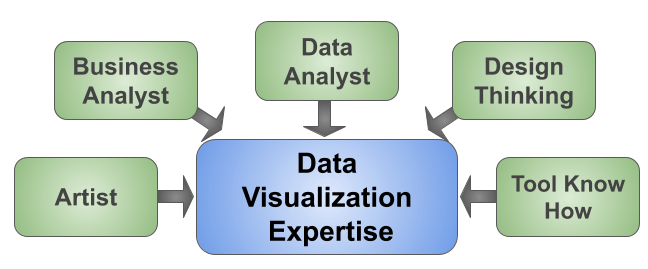
In my company, I’m recognized as an expert in Data Visualization, both through my expertise and my company wide community work to help educate and support work on data solutions across the company. (Expert is a relative term of course, but I think I know more than most!)
What do I mean by my expertise, here are some examples:
- I’m able to engage with stakeholders to understand the use case, elicit requirements and explore and iterate towards a solution.
- I have a good sense of design and a level of creativity which enables me to put together a dashboard that enables the power of tools like Tableau and Power BI.
- I can take a look at any dashboard and work with it’s creators to recommend how to improve it, applying visual best practices but also ensuring it provides actionable insight.
- I can analyse data sets and work out data quality issues and make clear the actions required to address these, enacting process change when necessary.
- I really understand how you want to set-up your data to meet reporting requirements for tools like Tableau and Power BI, whether this be working through business logic, data scaffolding or optimizing for performance.
- I have a good level of tool know how and know the art of the possible or how to work out the answers if I don’t.
- I don’t do all this work myself and have some great colleagues to work with, but I take the lead on providing the direction and approach and the ability to communicate what is required to data engineers, data analysts and visualization developers is key to this success.
How did this happen? Why am I good at this? What approach would I recommend to develop these capabilities?
A brief career history
I didn’t set out in my career to take this path, originally graduating with a Masters in Electronics and spending a few years working with mobile phones and other electronic solutions, I then moved towards IT, spending a fair few years developing project management and business analysis skills and working on a variety of programs and projects.
Back in 2013 I came across Tableau as an answer to a reporting requirement for one of our applications and immediately saw the potential of the tool (Tableau 8.0 at the time). Having had PMO (Project Management Office) roles as part of my career I knew first hand the frustrations of the Excel and PowerPoint ecosystem for reporting inefficiency.
Seizing upon this opportunity, I took it upon myself to self-learn how to get the most out of Tableau, working through the online webinars, reading blog articles, attending Tableau User Groups (London), reading books by Stephen Few and so forth.
As I connected with other like minded individuals across the company I initiated a in-company Tableau User Group to help raise the capability bar and encourage sharing of experiences as well as working with Tableau to help us understand the latest functionality.
A couple of years on I managed to move into a new role in one of our Big Data & Analytics teams with myself leading a team to deliver data solutions within the company.
Throughout that time and up to now I became more and more passionate about Data Visualization and as I became increasingly recognized for this within the company I took and made opportunities to present to people on the subject to help raise the culture and capability. I even had the joy of talking at the Tableau Conference a couple of years ago on the subject of data driven culture and you can check out the video.
As Power BI also proliferated within the company and recognizing the need for versatility I’ve also learnt a fair bit about that tool as well and provided guidance and best practice material some tool specific some just on the key principles around Data Visualization.
In fact I’ve now got a second role to the main day job heading up our Data Visualization Professional Services where we will provide education and best practice and guidance across the company!
Explore, Learn, Do
My background in engineering definitely embedded within me some good skills for solution design and critical thinking. I found a passion in Data Visualization and took and made opportunities to expand my knowledge and skills and further my career in this direction.
As I reflect over the past years I would break down my learning and capability in three main areas:
- Explore: There are loads of great information and resources to tap into, whether it be reading blogs, watching videos or learning the functionality in the latest tool updates. Community activities such as User Groups are another great asset (eg Tableau User Groups, Power BI User Groups and if you get the opportunity to attend conferences then go for it. Not that I have the time at the moment (two young boys recently joined our family), but community initiatives like Makeover Monday are another great way to learn.
- Learn: Online courses from LinkedIn Learning, Coursera, etc are a valuable way to learn. Tableau and Power BI have some great guided learning material. I also recommend Tableau’s Visual Analytics course as a great way to consolidate your learning and appreciation of Data Visualization fundamentals. There are also many books on the subject, I recommend Stephen Few’s Information Dashboard Design and The Big Book of Dashboards by Wexler, Shaffer and Kriebel, and definitely check out their Chart Chat series!
- Do: I definitely believe that you learn more by delivering solutions and overcoming challenges and learning new things. Balance exploring and learning with using the “tool in anger” and iterate your solutions towards success! I’ve also taken opportunities to work directly with our tool vendors to work through various problems and this is another good thing to do given the opportunity!
One guiding principle throughout all of this is Helping Out other people. Whether it be in your company or even via forums and other means, by helping other people you come across new situations and challenges which force you to expand your knowledge and capabilities. There is a balancing act to be met here (you can’t help everyone and you might want a work life balance), and also consider that by writing articles, recording videos and presenting at events you help a wider group of people. But I definitely believe by helping others and trying to solve all sorts of problems you will more quickly expand your knowledge and skills and develop and be recognized for your expertise.
 Data Visualisations in Corporations