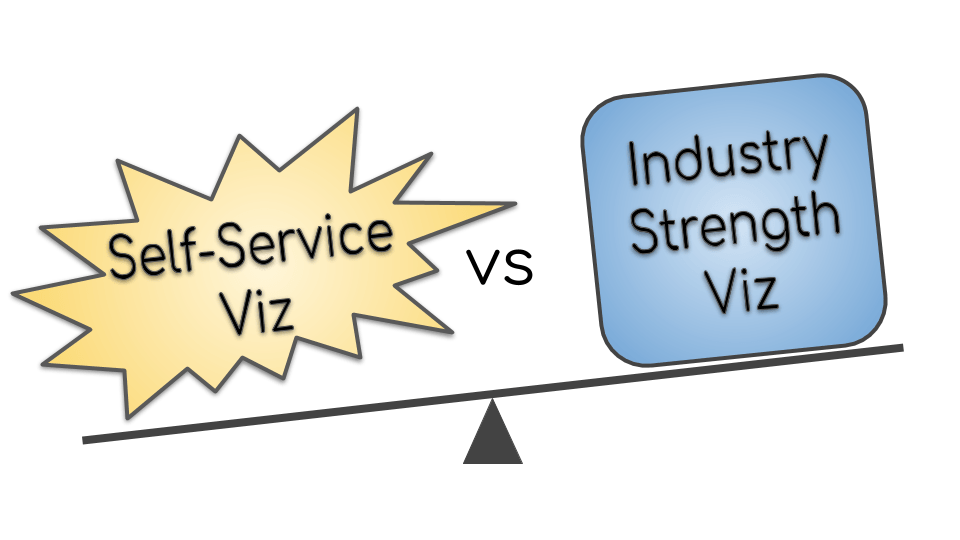
Self-service is great, enabling users with domain knowledge to quickly deliver and manage valuable solutions for the business without the need to have a budget, set-up a project and so forth. One off ad-hoc visualizations can also be quickly developed to answer specific challengers pertinent to the current business context.
Self-Service is the worst, users with little understanding build a “spaghetti mess” of data wrangling, in-efficient manual processes, each department doing their own version, terrible visualizations, incorrect numbers and lots of operational risk.
Industry Strength is great, delivered by your professional team of data engineers and data visualization experts, best-in-class solutions are delivered that scale across the business, providing insight with fantastic visualizations with a “design thinking” approach that delivers significant value for the business and is operational for the longer term.
Industry Strength is the worst, if and when you finally get budget, the delivery team don’t understand the business at all, the business team are too busy to help, and it then take ages to deliver a poor solution which fails pitifully, has data that can’t be trusted/isn’t relevant and no one even uses despite the management “enthusiasm”.
Modern BI tools like Power BI and Tableau enable self-service visualization at a level never seen before.
The truth is out there, and it depends on a range of factors, it’s not a black and white decision ; a balancing act between enablement and control.
There are two key approaches to consider:
- Capability and guidance for self-service users
- Guidelines of when to consider an Industry Strength solution
Capability and guidance for self-service users
Sufficient guidelines that most self-services users “do the right thing” (realistically never going to be 100%). Some key considerations:
- Encouragement to use certified data sources (ideally from your data lake, reporting warehouse or source systems).
- Automate as much as possible so that data automatically updates without manual intervention.
- Carefully designed and validated from a data processing and calculation perspective.
- Performance best practice guidelines to ensure a robust solution that doesn’t cause problems for the platform it runs on or the user experience.
- Design documentation/instructions so that the next person who looks after it has a “fighting chance”.
- Data visualization best practices – style guide and peer reviews.
- Data security and data privacy guidelines – protect the data appropriately and don’t run afoul of regulations.
- Differentiate between “sandbox” solutions and “production” solutions.
There is perhaps the argument to have some kind of “rubber stamp” of self-service solutions that meet a suitable level of criteria if you want to put the effort into set up such a service.
You then have to consider what controls and/or monitoring you do want to put in place to understand what is going on from a self-service perspective (assuming the technology enables it)
Guidelines of when to consider an Industry Strength solution
When does it make sense to get your data team to take on the solution (either from the start or taking over a self-service solution)? Here would be my top considerations:
- Critical business process.
- Frequency of reporting (daily, weekly more likely to be worthwhile due to inefficiency of managing using a self-service approach).
- Significant size of data set and/or complexity of requirements that requires specialist data engineering approaches.
- Scalable solution that can be replicated consistently across the organisation creating significant efficiencies.
- Dashboards are shown externally and need to be professionally produced to meet external requirements.
- Sensitive data that needs to be secured and managed using all the right controls.
However, if there isn’t the budget/priority then invariably if you have enabled self-service solutions then they will appear to fill the need with the potential for both good and bad consequences.
For self-service solutions that get “out of control” and can no longer be supported by the user/team (perhaps the person who developed it has left) it would seem to be prudent to have a process and team in place to take on such solutions to enable business continuity whilst a longer term solution is considered.
 Data Visualisations in Corporations